Physike Technology Co., Ltd.

Scryo-SV Top-Loading Continuous Flow Cryostat


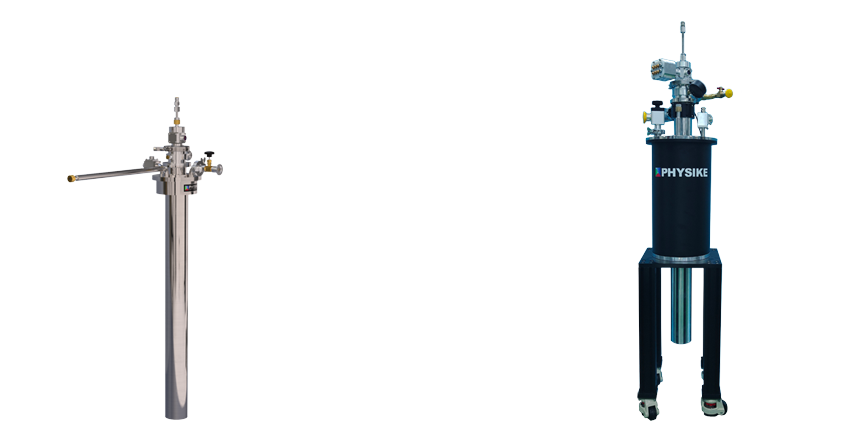
The Scryo-SV (abbreviated as SV) is a top loading continuous flow cryostat that utilizes a transfer piping with a needle valve to efficiently transfer liquid helium from the storage dewars into a vaporizer. The vaporized cold helium flows into the sample tube to cool the sample, which allows for adequate cooling of poorly thermally conductive samples (e.g., stainless steel, ceramics), irregularly shaped samples (e.g., DAC press), powdered samples, and liquids, with the option of a Static helium environment. Typical SV cryostat variable temperature range:<2K-325K, with optional 500K and 800K high temperature upper limits.

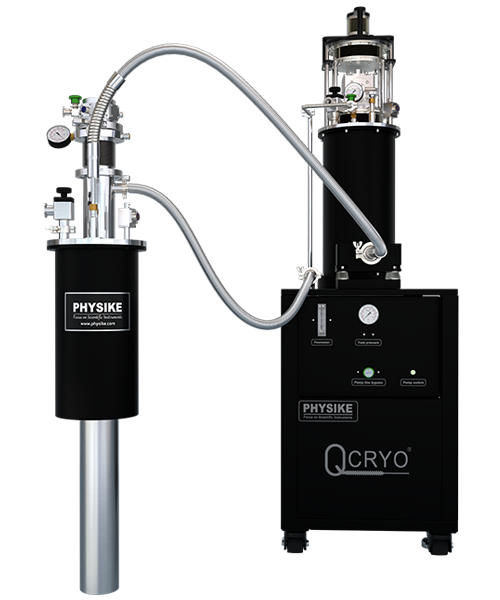
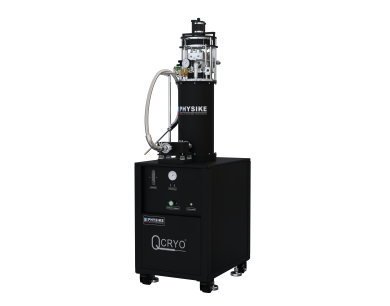
The SV cryostat has the characteristics of simple operation, fast cooling speed and wide applications, etc. It can use liquid helium to cool down, also can use liquid nitrogen to cool down, also can form a closed-loop dry cryogenic system with Helium Cycle Cryogenic System (Qcryo), which can be continuously operated for a long time at low temperature without consuming liquid helium, and keep the typical low vibration and low noise characteristics of SV cryostat, which saves a lot of cost comparing with the use of liquid helium. 
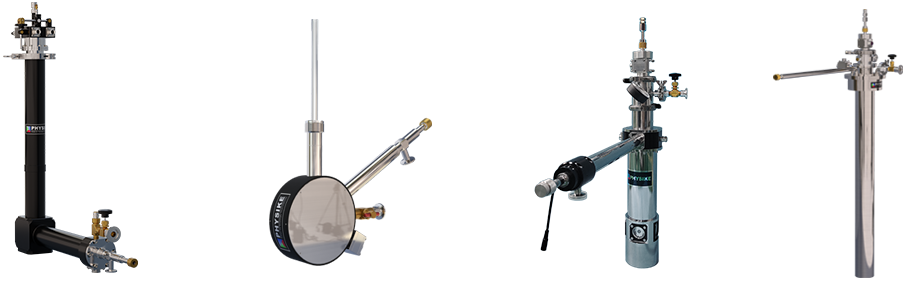

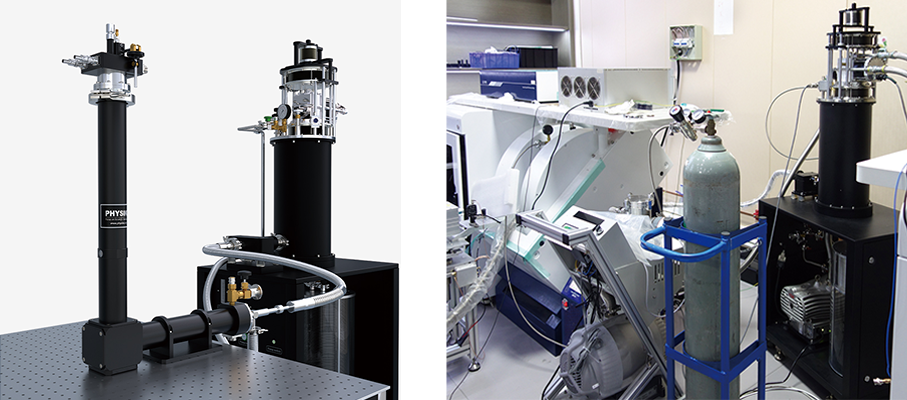
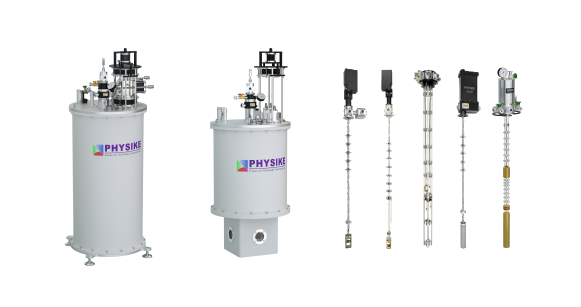
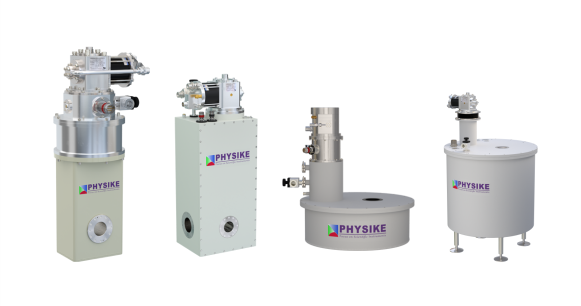
Several Typical SV Cryostats


Typical characteristics

Typical Sample Environment

Flow helium (option: static   exchange helium)

Nominal temperature range

<2k-325k

Temperature stability

±25mK

Typical Applications

UV/Vis/IR/THz, optoelectronics, electromagnetic   transport, AFM, near-field optics, ESR/EPR, NMR, 

Mössbauer spectroscopy,   high-energy physics, X-ray, neutron scattering, high pressure(DAC),

superconducting materials, dielectrics, quantum devices, and tensile   experiments

Note

1.  <4.5K   requires pumped liquid helium.

2.   No applied   loads.

3. Sufficiently high pumping speed and good ultimate   vacuum of the vacuum pump.


Option

Uniaxial/biaxial sample rods,  customized sample tube I.D., static helium/vacuum sample environments, 

vacuum feedthroughs such as multi-pin/SMA/BNC/fiber optic, twisted pair/flexible coaxial/semi-steel/triaxial/fiber optic, 

Puck/LCC/DIP/dielectric sample holders, multi-position sample holders/liquid holders, UV/Vis/IR and THz   windows, 

500K and 800K high temperature upper limits, Mylar, Kapton, Beryllium and Vanadium windows, etc.

Note

The SV cryostat combined with Helium Cycle Cryogenic   System (Qcryo) to form a closed-loop dry cryogenic system


SV-100 Cryostat

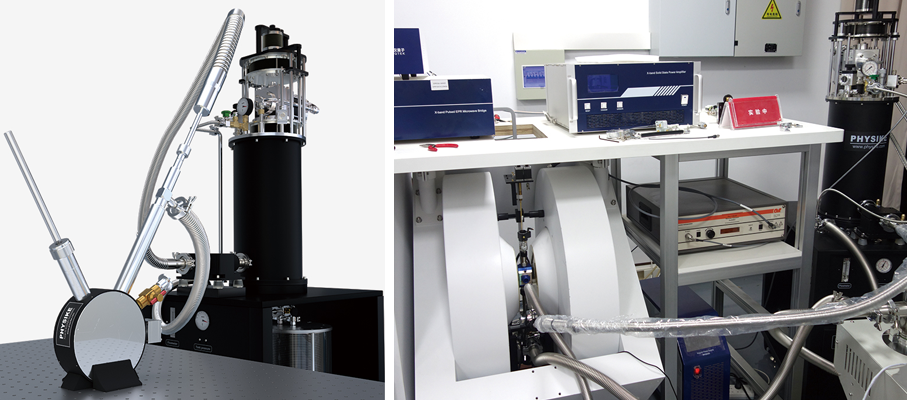
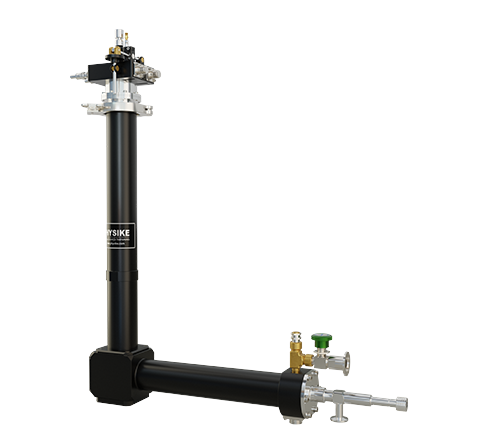
The SV-100 cryostat is specially designed for Q-band ESR spectrometers. It adopts the “L” shape design, which is easy to match with the ESR electromagnets, and the standard SV-100 sample environment is dynamic exchange helium gas, and the static exchange helium gas sample environment is optional.

SV-100 Cryostat


Dry top-loading cryogenic system for matching Q-band EPR spectrometers 

(Model: Qcryo-SV-100) 

It consists of two parts: the Qcryo Helium Cycle Cryogenic System and the SV-100 Cryostat. The SV-100 cryostat adopts a special static exchange helium gas sample environment, which not only avoids the blockage problem that occurs easily when changing samples in the dynamic exchange helium gas cryostat system, but also possesses the cooling ability similar to the dynamic exchange helium gas cryostat system. This dry cryogenic system operates without liquid helium consumption, is not limited by the volume of the liquid helium dewar, and can operate at the minimum temperature for extended periods. The temperature at the vaporizer after integration of the 34 GHz low heat-leakage microwave insert is less than 2.5 K, and the lowest temperature at the sample is below 2.8 K.


SV-200 Cryostat

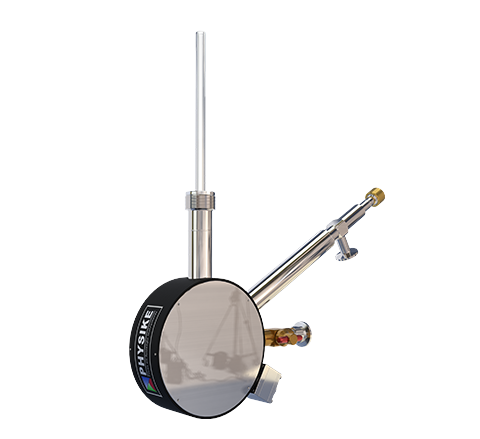
The SV-200 cryostat is specially designed to match X-band ESR spectrometers. The liquid helium is continuously transferred from the storage dewar to the vaporizer of the SV-200 cryostat using a transfer piping with a needle valve, and the vaporized cold helium flows into the double quartz tubes to cool the samples, which is especially suitable for matching with ESR electromagnets using a special compact design. The SV-200 cryostat's inlet and outlet piping is coaxial and provides adapters to match X-band microwave resonance cavities, which can be matched with most mainstream ESR/EPR spectrometers.

The SV-200 cryostat has a heater and field-independent calibrated thermometer mounted on the vaporizer and a field-independent calibrated thermometer mounted inside a double quartz tube, with a typical operating range of<2.5K-325K, with an optional higher temperature upper limit. In addition, the SV-200 is available with optional flow controller, mini-load-lock construction, vacuum pump and liquid helium/liquid nitrogen storage dewar.

 SV-200 Cryostat


The SV-200 cryostat can be used with either liquid helium or liquid nitrogen, and can be combined with a Helium Cycle Cryogenic System (Qcryo) to form a closed-loop dry cryogenic system to obtain temperature as low as 2.5K without the need to consume liquid helium.


Dry Cryogenic System for X-Band EPR Spectrometers

 (Model: Qcryo-SV-200)

It consists of a Helium Cycle Cryogenic System (Qcryo) and a SV-200 cryostat, where the sample is placed in cold helium gas flowing inside a double quartz layer, with an integrated mini-load-lock structure to avoid possible blockage during sample changes. This dry helium cryogenic system offers excellent performance without the need for liquid helium consumption, with minimum temperatures<2.5 K at the vaporizer and <2.8 K at the sample.


SV-300 Cryostat


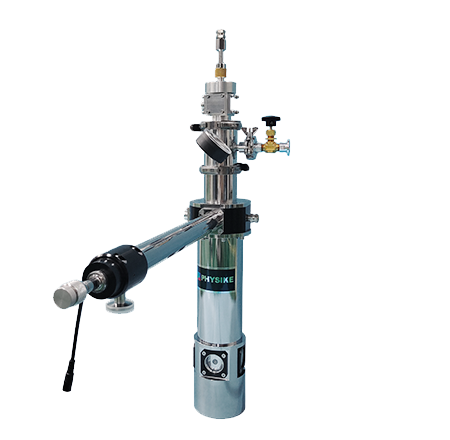
The SV-300 cryostat is a top loading continuous flow cryostat with four optical windows in the tail, easy to match with a variety of commercial spectrometers, and the tail size of the cryostat can be customized to meet the requirements of special optical experiments.

The cold helium environment of the SV-300 cryostat adequately cools samples with poor thermal conductivity (e.g., stainless steel, ceramics), irregularly shaped samples (e.g., DAC press), as well as powders and liquids, while the four sets of optical windows at the end are very convenient for optical experiments.

SV-300 Cryostat

The SV-300 cryostat utilizes stress-relieved cryogenic windows that greatly reduce the risk of leakage at low temperatures from sample tube mounted cryogenic seals. The SV-300 cryostat offers a variety of options, such as an integrated multi-position sample holder on the sample rod and a linear actuator to allow for the testing of multiple samples at cryogenic temperatures, a vibration-reduced static exchange of helium for sample environments, and the availability of mounting flanges to match the spectrometer as well as windows for various wavebands, etc.

The SV-300 cryostat can be cooled not only with liquid helium, but also with liquid nitrogen. The SV-300 cryostat is combined with a Helium Cycle Cryogenic System (Qcryo) to form a closed-loop, dry cryogenic system that can operate continuously for long periods of time at cryogenic temperature without the need to consume liquid helium.


SV-400 Cryostat

The SV-400 Cryostat is a top loading continuous flow cryostat with a tubular tail, where the sample is in the flow of cold helium, effectively cooling samples that are difficult to thermally anchor, samples with poor thermal conductivity, and irregularly shaped samples. The SV-400 Cryostat transmits liquid helium through highly efficient, super-adiabatic transfer piping, and its compact design avoids clashing with the various valves and lines above the top flanges of the magnets' Dewar tops, etc. The SV-400 cryostat is easily matched to room temperature bore superconducting magnets/water cooled magnets/hybrid magnets. Typical operating range:<2K-325K, with 500K or 800K high temperature upper limits available as an option.

Typical applications of the SV-400 cryostat include near-field optics, NMR, ESR/EPR, AFM, Mössbauer spectroscopy, neutron scattering, high-energy physics, quantum devices (e.g., Squids devices, TES devices), high pressure (DAC), electromagnetic transport, dielectrics, superconducting materials, and materials stretching, etc.

The SV-400 cryostat can not only be cooled with liquid helium or liquid nitrogen, but can also be combined with a Helium Cycle Cryogenic System (Qcryo) to form a closed-loop dry cryogenic system (Qcryo-SV-400), which allows<2K cryogenic temperatures to be obtained without consuming liquid helium.

The SV-400 cryostat is ideally suited to match NMR magnets, for example, the SV-400 sample tube that matches a typical 9.4T aperture 89mm NMR superconducting magnet has an inner diameter of 65mm, and can be customized with different outer diameter tails to match magnets with different apertures.

SV-400 Cryostat for NMR Spectrometer (left)& SV-400 Cryostat for Tensile Experiments of Low-Dimensional Materials (right )


Large sample chamber top loading dry cryogenic system 

(Model: Qcryo-SV-400)

A static exchange helium sample environment with sample tubes up to 80mm I.D. and a minimum temperature of<2.5 K. The cryogenic system's ultra-low vibration and large sample space characteristics are well suited for experiments such as cryogenic confocal microscopy, RAMAN, AFM, STM, and quantum optics. In addition, the cryogenic system's tubular tail is compatible with room-temperature bore uniaxial or multi-axial magnets.