Scryo-SDV Storage Tank Cryostat
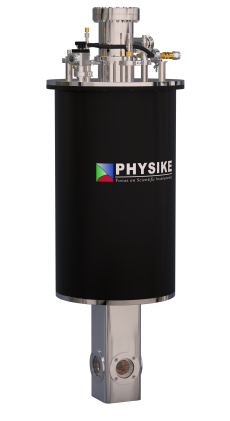
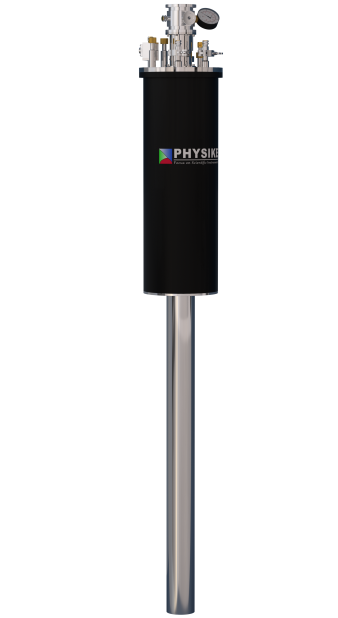
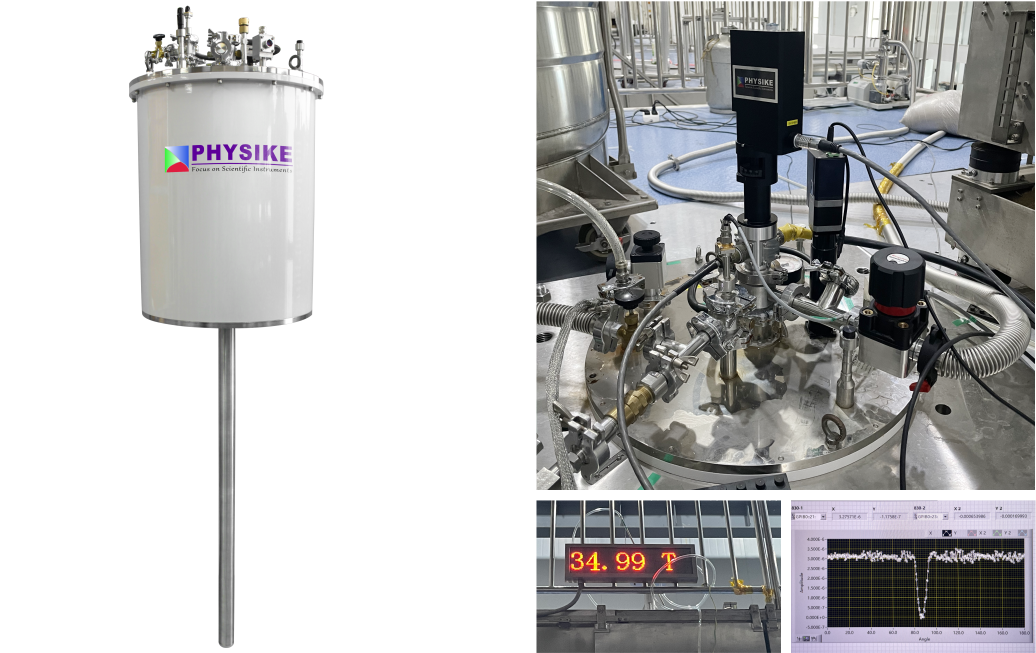
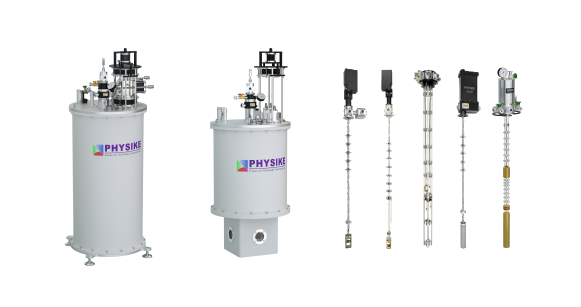
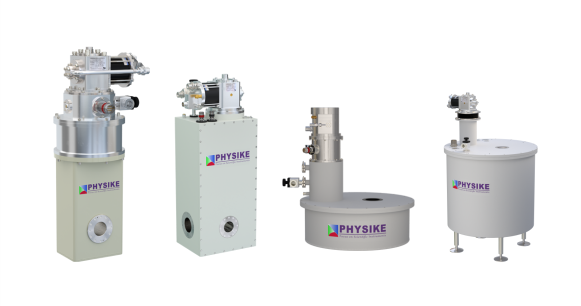
The Scryo-SDV (abbreviated as SDV) storage tank cryostat comes standard with dual tanks for liquid helium and liquid nitrogen, integrated variable temperature inserts, and a top-loading design that allows for quick sample changes by inserting and removing sample rods.
The SDV cryostat utilizes an ultra-low heat leakage design with an extremely low liquid helium consumption rate, making it particularly suitable for long-running experiments. The liquid nitrogen reservoir blocks heat leakage from ambient radiation to the liquid helium reservoir and the variable temperature insert, and the ultra-insulated design between the sample tube and the reservoir allows the cryostat to maintain a very low helium consumption rate at a higher temperature, and the innovative design prevents a significant increase in the helium consumption rate when the liquid nitrogen level is very low.
The SDV cryostat can be supplied with a slim tail to match electromagnets, superconducting magnets, and hybrid ultra-high magnets for electromagnetic transport testing, vibrating sample magnetometer testing, Hall effect, ESR/EPR/NMR, high-energy physics, and high-pressure (DAC presses and hydrostatic high-pressure packages).
The SDV cryostat can be fitted with experimental windows made of different materials to transmit γ ray, X-ray, UV, visible light, infrared to terahertz, etc. Typical applications include photoelectricity, magneto-optical, infrared/Raman spectroscopy, X-ray, neutron scattering, Mössbauer spectroscopy, etc.
The SDV cryostat can be equipped with an optional sample rod with linear actuator, single/dual axis rotating sample rod, puck sample holder, in-situ pressure regulating sample rod, AC magnetic susceptibility testing, etc. Options such as multi-pin connectors, BNC, SMA, fiber-optic vacuum feedthroughs, twisted-pair, coaxial/tri-coaxial, RF semi-steel cables, and fiber optics are available.
The SDV cryostat can also be equipped with an optional static helium gas environment, which is designed to be particularly suitable for vibration-sensitive experiments such as AFM, STM, near-field optics, magneto-optical and others.